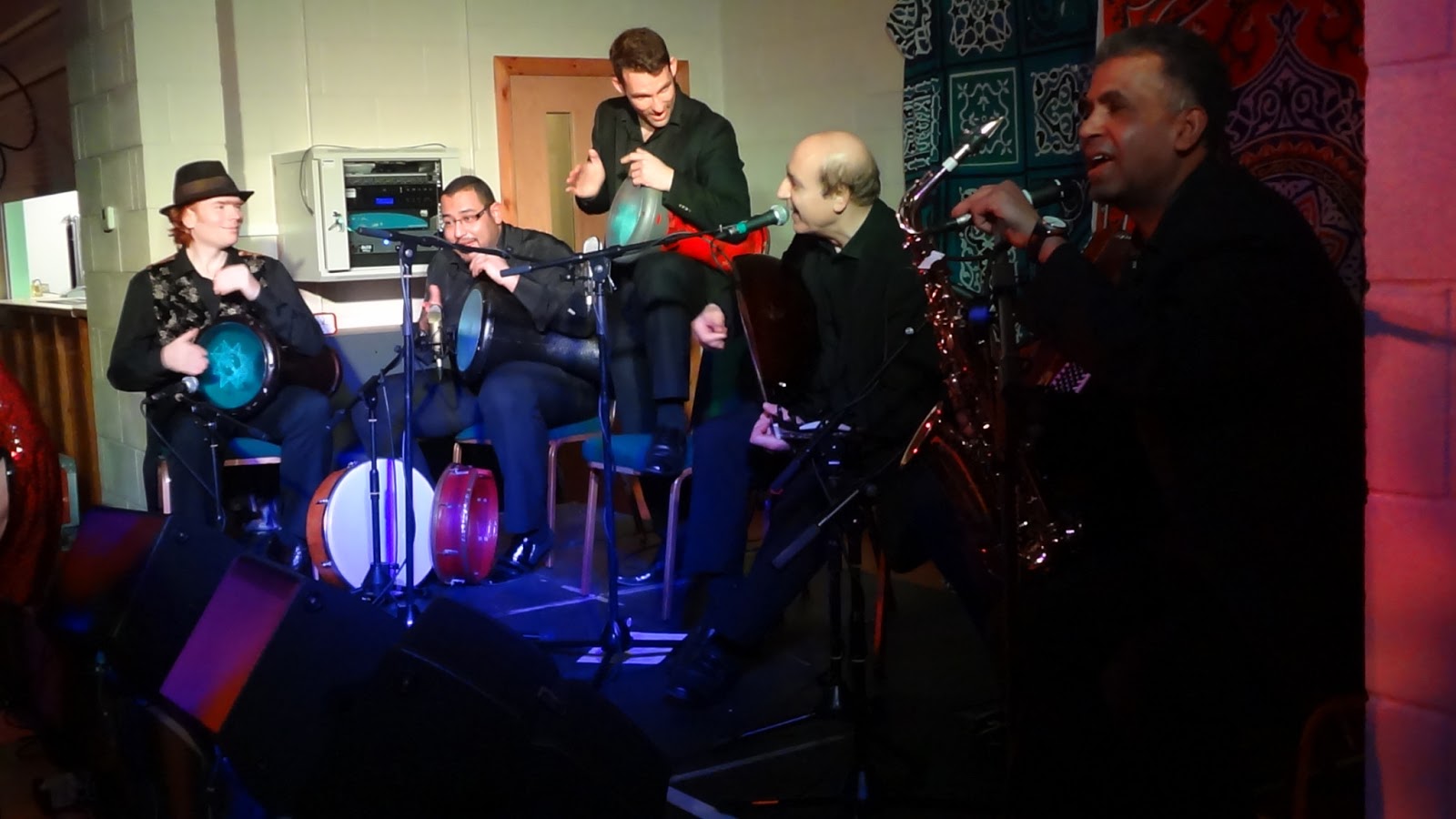
The Baladi Blues ensemble is led by darabuka (Egyptian tabla) player Guy Schalom. The regular line up includes Adam Warne on frame drum and riq, Ahmed El Saiidi on saxophone and Sheik Taha on accordion. Guest artists were Ali El Minyawi on daholla and Abdul Salam Kheir on oud and vocals.
If you haven't heard all about it yet, Guy Schalom - talented darabuka player, dancer and leader of the Baladi Blues Ensemble - recently recorded a programme for BBC Radio 4 all about traditional Baladi Egyptian music and dance.
Bellydancing and the Blues
Bellydancing and the Blues was broadcast on Boxing Day at the end of last year. The good news for anyone who didn't manage to tune in on the day is that the programme is available to listen again on BBC iPlayer on a permanent basis.
The is an insightful documentary about a traditional form of Egyptian music and dance and how both developed and grew through interplay between east and west. There are some fascinating contributions from distinguished musicians and dancers from Germany, the UK and Egypt including Raqs Sharqi Society trained Jane Wass, music producer Jennifer Carmen and Egyptian accordion master Sheik Taha. I particularly loved hearing a different spin presented to the history of belly dancing past and present. And as a real bonus, the whole show is ornamented with musical excerpts of beautiful Egyptian music, including from Guy's own Baladi Blues series of CDs.
Guy Schalom
Here's an extract from the blurb on the BBC website:
"Dancer and drummer Guy Schalom hunts out the spirit of the new Egypt in one of its biggest cultural exports. To our ears, Baladi is the music of the bellydancer - kitsch and mock-Arab. But in its true form it is the essence of Egypt, 'of the country', 'home' in the deepest sense..."
To listen to the programme in full go to BBC iPlayer.
Here is my second post about resources I've used for teaching myself zills. My previous post talked about learning from online videos. This time, some information about the stuff I've been doing to learn to play Arabic rhythms.
A while back, I took some drumming workshops with the very talented Tim Garside. Tim is an incredibly talented musician who plays many different percussion and musical Arabic instruments. Tim teaches around London, and these classes were on offer at Raqs Sharqi Society events. He's a great teacher with a mild manner and dry sense of humour. Alongside the workshops, he gave us a couple of photocopies of handwritten notes on Egyptian rhythms. This covered all the basics, each with a core rhythm - including Maqsoum, Saaidi, Masmoudi, Malfuf, Zaar and Fellahi - transcribed in simple form, and then followed by one or more additional versions with elaborations.
I've been learning and practising all these rhythm variations straight off the handouts. My current technique has followed on from this study and relies on using the same hands to play my zills as I would if I was drumming. The general rule of this method is for my right hand to play all the "dums" and "taks", and then my left to play the filler "ka"s. I also differentiate these groups of notes with different sounds. For dums, I select an open ring sound, and for taks a slight muted tone. I seem to remember drummer Chas Whitaker, suggesting this to a group of dancers once. I also add in the left handed ka, again with a softer mute tone. This interpretation is perhaps where I feel I'm on uncertain territory. From the you tube videos and recordings so far, there seems to be quite a lot of variation in how the different sounds are expressed. In their drills, Ansuya and Mahin played a consistent ring across all the notes. However, I've seen and heard other dancers use more texture in their sounds including Artermis and Sophie Armoza.
I've also been drilling the same rhythms with a dampened zills tone, although trying to maintain some tonal differentiation between dum and tek. I think the benefits of sticking to the drumming fingering (the term perhaps could better be described as handedness, although I'm not sure) is that my learning would transfer better, if I had the opportunity to learn more drumming.
Consistent with this approach, I found a short series of YouTube darabuka tutorials from RexSoli. He additionally covers the split hand technique, for playing faster rhythms like Malfuf (where dums are played with the dominant hand, and taks with the other hand). This is easy to replicate on zills, and makes some rhythms a lot easier to play. Here is Rex in action:
The approach of following the drummers' language for rhythms (what Artemis calls "drum speak" - including the dums, taks and kas - makes sense to my brain. I found this easier than counting variations (e.g. 123- or 1-&-a-2-) or using "RLR" type transcriptions. The consequences of this approach also means opening up countless resources that transcribe rhythms and their variants. In fact, there are heaps of free online resources written in this format. There are far too many to list here, although one favourite I really liked for quantity of information ease of use is the info on the website Khafif.