Showing posts with label Egyptian Dance. Show all posts

Monday, 18 March 2013

Baladi Blues Live - More photos from the NADA AGM

Here is a selection of my own photos I took at the NADA AGM in Lancashire, featuring Guy Schalom and the Baladi Blues Ensemble. You can also read my previous post with photos of my solo with the band.
Guy Schalom and the Baladi Blues Ensemble
Claire Novis and the band
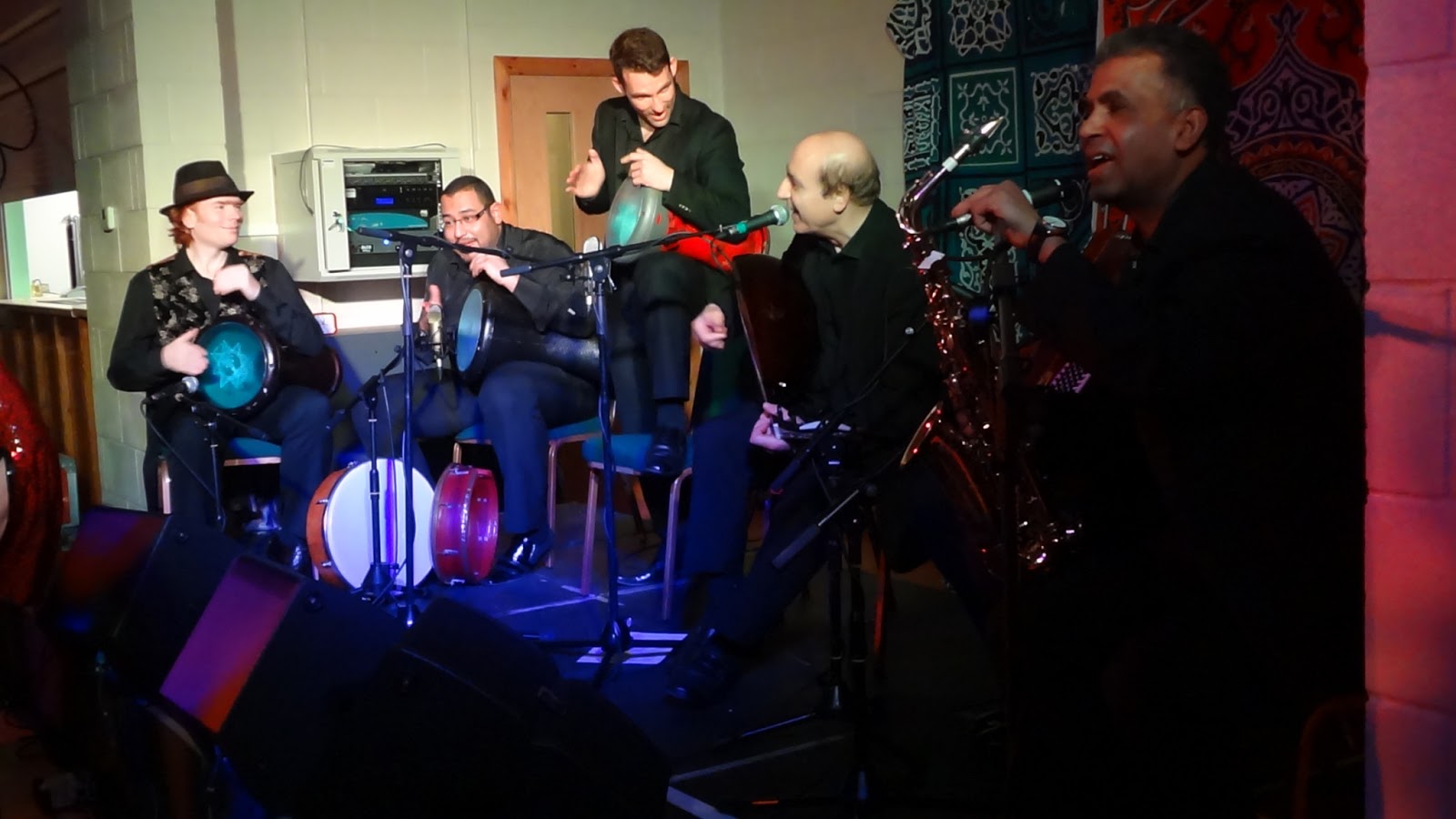
The Baladi Blues ensemble is led by darabuka (Egyptian tabla) player Guy Schalom.  The regular line up includes Adam Warne on frame drum and riq, Ahmed El Saiidi on saxophone and Sheik Taha on accordion.  Guest artists were Ali El Minyawi on daholla and Abdul Salam Kheir on oud and vocals. 
Melody from Abdul Salam, Taha and Ahmed

Rhythm from Guy, Adam and Ali

All eyes are on...
...Katie Holland

Getting into the groove

Monday, 25 February 2013

Dancing at the NADA AGM and my new Baladi dress

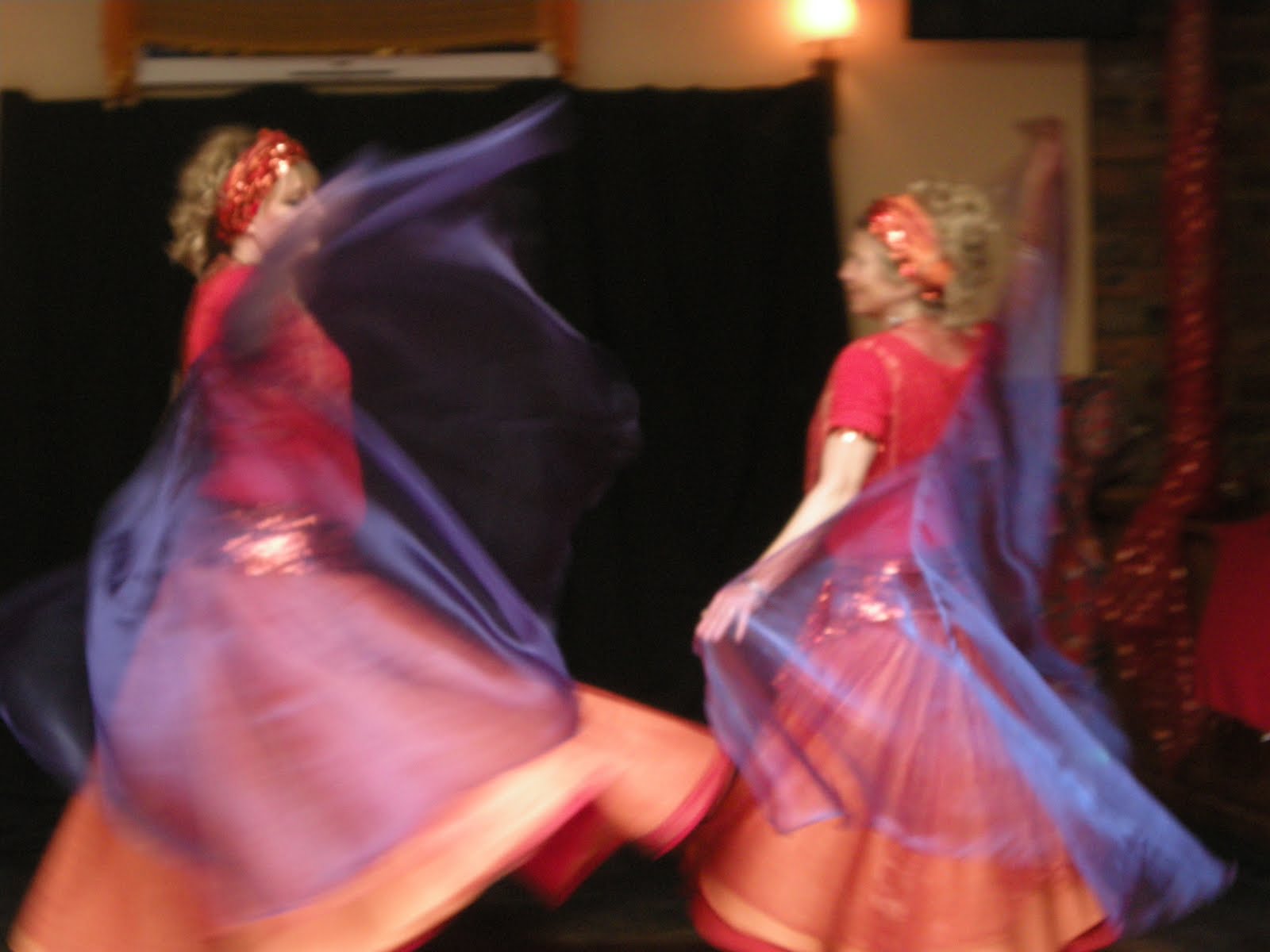
Here are some fabulous photos by Philip Welsby of my performance at the NADA AGM with the Baladi Blues Ensemble, in Lancashire last week. 

Dancing at the NADA AGM, Lancashire
The pictures also show off my new Baladi dress by costumier Wendy Holyer.  I love how it turned out, especially the sleeves.  The main fabric is from my recent trip to Goldhawk Road.  And the blue trim is fabric I bought back form Cairo a few years back.

Performing with the Baladi Blues Ensemble
I performed a solo Baladi progression to Amint Billah, which I chose as I knew Sheik Taha would be playing the accordion, who was instrumental in his contribution to the Ashra Baladi structure.   Although I'd practised to various versions of this song beforehand, the music on the night turned out completely different and so my performance was entirely improvised.  I truly love how with Baladi music, the combination of musicians and dancer brings out a completely different result every time.  It was also a lovely and welcoming crowd of fellow dancers and the whole evening was a joy.   

New Baladi dress

With Sheik Taha and Ahmed El Saidi

Dancing with the Baladi Blues Band

It was an amazing night and a fantastic privilege to dance to such wonderful musicians.  A big thank you to NADA for the opportunity. 


Monday, 4 February 2013

Bellydancing and the Blues

If you haven't heard all about it yet, Guy Schalom - talented darabuka player, dancer and leader of the Baladi Blues Ensemble - recently recorded a programme for BBC Radio 4 all about traditional Baladi Egyptian music and dance.

Bellydancing and the Blues

Bellydancing and the Blues was broadcast on Boxing Day at the end of last year.  The good news for anyone who didn't manage to tune in on the day is that the programme is available to listen again on BBC iPlayer on a permanent basis.  

The is an insightful documentary about a traditional form of Egyptian music and dance and how both developed and grew through interplay between east and west.  There are some fascinating contributions from distinguished musicians and dancers from Germany, the UK and Egypt including Raqs Sharqi Society trained Jane Wass, music producer Jennifer Carmen and Egyptian accordion master Sheik Taha.  I particularly loved hearing a different spin presented to the history of belly dancing past and present.  And as a real bonus, the whole show is ornamented with musical excerpts of beautiful Egyptian music, including from Guy's own Baladi Blues series of CDs. 

Guy Schalom
Here's an extract from the blurb on the BBC website:
"Dancer and drummer Guy Schalom hunts out the spirit of the new Egypt in one of its biggest cultural exports. To our ears, Baladi is the music of the bellydancer - kitsch and mock-Arab. But in its true form it is the essence of Egypt, 'of the country', 'home' in the deepest sense..."
To listen to the programme in full go to BBC iPlayer. 

Sunday, 21 October 2012

Kate's Baladi

Kate Deacon is a Scottish teacher of Raqs Sharqi style Egyptian Dance.  She runs several classes in the Borders and Lanarkshire.  She originally trained with my teacher Lorne McCall and I think she's a beautiful dancer.

Kate doesn't perform so often these days, but Susan Tonner of Katra and Twisted Tails posted this video of her dancing in Edinburgh a few weeks ago, in a special event featuring Carolena Nericcio of Fat Chance Belly Dance.  This is a lovely example of the Raqs Sharqi Society style of Baladi - simple, sweet and melodic; with patterns in space and geometric motifs. 


Monday, 6 February 2012

Thank you for the music!

Thank you Northern Arabic Dance Association for last night's fantastic live music event in Edinburgh with the Baladi Blues Ensemble!
Thanks to your support: 8 people got to dance in the evening show; another 8 led the musicians in the workshop; 21 in total enjoyed a workshop with live musicians; 1 person had her first experience teaching a live music workshop; 10 people went to their very first bellydance class; and over 115 people enjoyed our party and performances to fantastic live Egyptian music from the Baladi Blues Ensemble!

For many that were there this was their first experience of hearing or dancing to live Arabic music, for others this was the first time they had ever seen Arabic dance or belly dance. For all of us, this was a very special occasion, with a beautiful warm atmosphere and a fantastic finale for a whole weekend of amazing events like this around the country.

Thank you to everyone at NADA, all of its members, committee, to Coordinator Anna Bisco, to Elspeth SwishandHips, all the volunteers and helpers, the staff at the David Lloyd Newhaven, and to the incredible Baladi Blues Ensemble - Guy Schalom, Sheik Taha, Ahmed El Saidi and Adam Warne!

Thank you to all of you for spreading the Baladi Love!

Sunday, 29 January 2012

Baladi Blues Band - Live Arabic Music in Edinburgh

On Sunday 5th February 2012, I am hosting the Baladi Blues Ensemble, live in Edinburgh, for a day of Egyptian Dance.
Day of Dance Flyer
All the details, including bookings information, venue, directions and accommodation info are on my website.

The aim of this event is to bring live music and Egyptian Dance to communities that might not otherwise get the chance to experience it.  That’s why we have arranged a free taster workshop as part of the day.  And that’s also why we’ve kept the cost of participation very low – thanks to the generous sponsorship of NADA, the Northern Arabic Dance Association.

Baladi Blues Ensemble

The Baladi Blues Ensemble plays the urban Egyptian dance music known as Baladi. Skillful accordion and saxophone improvisations, energised by powerful Egyptian rhythms give the Baladi Blues Ensemble its distinctive sound. Their music reflects the sophisticated and fast paced, urban lifestyle of 1950’s Cairo - all offered with a charming and enigmatic stage presence.

Baladi Blues Ensemble
The group is led by renowned percussionist, Guy Schalom, and features legendary quarter-tone accordionist Sheik Taha (Mohamed Abdel Wahab, Ahmed Adaweya, Fifi Abdou, and Tahia Cariocca), saxophonist Ahmed El Saidi (Ali Hassan Kuban, Shams Hussein, Salamat) and master percussionist Hassan Reevis (Abdel Halim Hafez, Ahmed Adaweya).  The band also features frame drum wizard Adam Warne.

Venue 

The venue is the Forth View Suite at the David Lloyd Club, Edinburgh Newhaven Harbour, EH6 4LX.   Venue details, map, transport etc. information is available here.

Day

The day will feature:
  • FREE Egyptian Belly Dance taster workshop (2:00pm till 3:00pm)
  • Live music workshop for Dancers (3:15pm till 5:15pm)
  • EVENING CONCERT and party with live music (starts 7:30pm)
Evening concert and party with the Baladi Blues Ensemble
Starts 7:30, cost: £5! (LAST FEW TICKETS)

This unmissable concert and party will feature authentic live music from the fabulous Baladi Blues Ensemble, along with dance performances and lots of time to boogie with the band!

A fantastic evening of live music, featuring performances from me, Lorne, Espeth, Kerimeh, Anna and Edinburgh's longest established Egyptian Dance troupe Daughters of Isis.

Tickets are selling very quickly for this event, advanced booking is advised. 

FREE Egyptian Belly Dance taster workshop for Beginners
2:00 till 3:00, cost: FREE

A fun, free, accessible dance workshop suitable for all ages and abilities.  This will be a fun filled introduction to Egyptian Dance for complete Beginners, brought to you by Dance Base's Elspeth SwishandHips.

To join the FREE workshop, either reserve your place in advance or simply turn up on the day, 

The Spirit of Baladi - Live music workshop for Dancers
3:00 till 5:00 (SOLD OUT)

I am teaching a workshop for dancers on "the Spirit of Baladi", accompanied by Baladi Blues band leader Guy Schalom on Egyptian Tabla and master accordion player Sheikh Taha - an opportunity to learn to connect with and dance to traditional Egyptian music, melody and rhythm, and to explore moving the soulful sound of Baladi accordion - played by one of the leading musicians of this incredible art form.  

Bookings

To book, go to bookings page on my website and follow the instructions.

For evening tickets, all reservations will only be held if secured by full payment (you can pay via PayPal) and the last date for Advanced Bookings and Payment is Friday 3rd February.

If any evening tickets remain after 3rd February than these will be sold on the day on a first come, first served basis.

Wednesday, 28 December 2011

2011 - 12 months in 12 sentences

I've risen to the challenge to summarize my 2011 year in just 12 sentences, one per month. Thanks go to Claire (@StAndrewsLynx) for the inspiration to blog on the "12 in 12" theme. And to those reading this - Happy New Year!  I hope that 2012 brings good things to you, and everyone. 

In January, I found some mezze (I also survived my worst costume malfunction but quickly destroyed all evidence).

I had a Fifi February, dancing with melaya and white galabeya. 

In March, I fed my fabric shopping habit during a trip to Paris, and Walked the Walk with a little bit of Aziza. 

April was a JoY, and workshops with Eman Zaki had me dancing Samia style. 

Jewel of Yorkshire with Khaled Mahmoud and Eman Zaki
In May, I had a Dorothy moment in the wrong dancers holiday in Marrakesh; and later danced the Zarr with Suraya accompanied by drumming from the father and son El Minyawis.  

Marrakesh
In June, I taught and guest starred at the second Glasgow Festival of Arabic Dance. 

Dancing at GFAD, by Milla

July was the Raqs Sharqi Society fundraiser in London, and the Foundation for Community Dance summer school - where I completed their certificate in Age Inclusive Practice.

August brought injury, which caused me to miss my guest star spot at Planet Egypt in London.

September, I had a really good time watching other dancers while I gradually got my body moving again.

October had me up, dancing again and joining Beatrice Grognard's workshops as part of the Songe d'une nuit en Egypte weekend.

November brought a thankfully snow free drive home from Northern Lights at Newport on Tay.

December meant lots of hours planning the Baladi Blues live Egyptian music event in Edinburgh next year - on 5th February 2012 - and I even sold out the live music dancers workshop that I'll be teaching then. 

Baladi Blues day of dance

Sunday, 20 November 2011

Choosing Your Music - Advice for Students

The first Arabic music CDs I bought were albums containing the tracks my teacher was using in class and for class choreographies.  When I was starting out, I also frequently browsed the world music sections of the big music shops and came away with some good starter compilations including numerous titles containing a taster of music from a particular region or title, for example Rough Guide - which can often include a pretty decent selection of tracks.  The good stores will also let you listen to the music before you buy.

I have to admit, I've not fully embraced the digital world when it comes to my music collection and I am very attached to owning the actual CD containing the tracks I am after.  And yes, it's important that these are the originals.
Windows of l'Institut du Monde Arabe, Paris
From here I moved on to the independent stores and suppliers.  These will often let you listen before you buy and often contain the more interesting international and independent labels.  In Edinburgh, I will always drop into my favourite music shop, the traditional folk music store Coda whenever I am passing.  They have a good world music section with a small rack of Arabic music and you can always find albums from the well known international artists featured there, and from the world or traditional music radio shows on Radio 2 and Radio Scotland.  They also stock independent titles and I've frequently seen CDs from UK based Arabic music talent appear there.  They will also let you listen to any CD before you buy and have a great sound system.  Also if you're lucky, Coda sometimes has some great special offer prices and the sale rail can also turn up the odd gem.  Hilary's Bazaar is another place worth browsing for CDs and definately worth a visit.  This store doesn't tend to be as competitively priced as the online retailers.  However, it has a big selection, including a number of rare titles, and you can ask for advice and listen too.  

My other main trick for buying great Arabic music is browsing for my collection wherever I happen to be on holiday.  This can often include the big chain music stores like fnac.  Certainly different countries in Europe will often have various middle eastern communities in their midst, so browsing through a store catering for local tastes whilst abroad can open the doors to many new titles and lables.  For example, on a trip to Paris a few months ago, I made a special trip to l'Institut du monde arabe, just to go to their bookstore and browse through a complete set of music titles from their own label.

This post responds to Emma Chapman's article on Choosing Your Music, a blog entry aimed at advising her students.  Emma is a Cambridge based professional belly dancer and her handy guide contains some great tips on where to start and useful links.  A nice little introduction for any student, particularly those accessing Arabic dance from a Modern Egyptian style perspective.
Emma Chapman

Sunday, 23 October 2011

Breathing New Life into an Ancient Legend

Dream of an Egyptian Night (Songe d'une Nuit d'Egypte) is a contemporary dance show; which takes its inspiration from the Egypt of the pharaohs, and the goddess Hathor.
(c) Tarab of Egypt
The legend of the goddess Hathor has enabled Béatrice Grognard and her dancers to plunge into the dazzling artistic and intellectual richness of the Egypt of the pharaohs.  Thanks to its musical excerpts drawn from numerous Egyptian repertoires and to the projection of paintings, sculptures, objects and antique sites, Dream of an Egyptian Night aims to celebrate an art which spans two millennia.  The show combines both ancient Egyptian spirituality and sensual pleasure; reflecting Béatrice Grognard’s fifteen years of research and experience of creating performances.  

“A celebration of the powerful femininity of the sun which is a mysterious expression of the beauty of the world and the magic beyond…”
(c) Tarab of Egypt
When the show debuted in Brussels last year it drew critical acclaim and was even featured on Egyptian television’s “Good Morning Egypt” news programme (Sabah el kheir ya Masr) and the Belgian news on Télé Bruxelles.  Here is a short clip from the original show.


Songe d'une nuit d'Egypte - Tarab / Béatrice... by tarabofegypt

You can watch further clips of extracts from the original show (Songe d’une nuit d’Egypte) on the Tarab video channel on Daily Motion.

The exciting news is that thanks to Ellie Atkinson of Zahira Dance and Raqs Sharqi Dorset, and after playing to audiences in Belgium, France and Italy, this amazing show is coming to UK this autumn – to theatres in Bristol in October and Leeds in November! And more good news, both shows will be followed by 2 days of workshops.  Here are all the details.  

Bristol show
Friday 28 October 2011, doors at 7.30pm. 
Queen Elizabeth Hospital Theatre, Berkley Place, Clifton, Bristol, BS8 1JX. 
Tickets are £16.50 including booking fee
To reserve go to www.bristolticketshop.co.uk.

Bristol workshops
Dance Space at the Island (Bridewell St entrance), Bristol, BS1 2PY
Saturday 29 October, 11:30-16:00 - Baladi
Sunday 30 October, 9:30-14:00 - Sha’abi (the rural style from Upper Egypt)
Each workshop costs £45
Bookings can be made by contacting Ellie Atkinson.

Leeds show
Friday 18 November, doors at 7.30pm.
Northern Ballet Theatre, Quarry Hill, Leeds, Yorkshire LS2 7PA. 
Tickets are £16.00 including booking fee. 
To reserve go to www.northernballet.com. 

Leeds workshops
Northern Ballet at Quarry Hill, Leeds, Yorkshire, LS2 7PA
Saturday 19 November, 11:30-16:00 - Classical from the ottoman courts
Sunday 20 November, 9:30-14:00 - Sufi.
Each workshop costs £45
Bookings can be made by contacting Ellie Atkinson.

Béatrice is an inspirational and generous teacher of her own particular style of contemporary and theatrical Egyptian dance. I’m so excited by this that I’m even planning to travel from my home in Edinburgh to both Bristol and Leeds weekends so I can attend both workshop weekends and I’m even thinking of seeing the show twice.  I’m particularly excited by the Sufi style, I’ve only done this a handful of times before with Béatrice and it is an incredible experience, not to be missed. 

Béatrice Grognard is one of the foremost European teachers of contemporary Egyptian Dance.  I first discovered Béatrice Grognard when I started attending her classes when I worked in Brussels for a spell in 2006. Attending her classes twice a week was a wonderful escape from what was a very busy but exciting period in my life. And since returning to the UK, I have continued to train, attending Béatrice’s occasional UK workshops and participating in two of her study trips to Egypt to work with live musicians. 

At the end of last year, I attended an amazing weekend of workshops with Béatrice organised by Diane and Ellie of Raqs Sharqi Dorset.  The learning was deep and amazing.  The Baladi focused on the meeting between singer, musicians and dancer, melting together like hot chocolate into a single melody.  The Ghawazee class helped us to explore strength, femininity and most of all fun, working with signature moves like throwing hips, twists, dynamic movements, wide shimmies, and rhythmic footwork.  And the jewel in the crown of the workshop weekend was Sharqi, the modern and classical form of the dance, almost contemporary in its interpretation.  Béatrice opened our eyes to challenging all our assumptions about how to interpret the music, unpicking many years of learning the “correct” way to dance.

About Béatrice Grognard

(c) Tarab of Egypt
Béatrice Grognard divides her time between Europe, Cairo and Brussels where, in 1998, she founded the "Tarab”, School of Theatrical Dances of Egypt". She has dedicated the last 15 years to the study and research of Egyptian music and dance. Trained as an archaeologist, Béatrice has always had true passion about arts and dance. Since 1991, Béatrice has devoted herself exclusively to dance and choreography and, thanks to her tremendous enthusiasm, has dedicated herself to defending the beauty and the authenticity of traditional Egyptian dances. Her quest today is directly linked to her original interest in archaeology: to bring forward Egyptian dance and the music of the past, redefine their boundaries and breath new life into them with theatricality introduced on stage, therefore ensuring them new life and a future.  For more information about Béatrice, see www.tarabofegypt.com.

www.habibadance.com

Tuesday, 6 September 2011

"Lauren of Arabia"

Egyptian percussionist, musician and dancer Karim Nagi has posted this great clip of a lecture he gave from a panel discussion in the Diwan 2009 conference at the Arab American National Museum in Deerborn Michigan, USA. Karim discusses the Americanization of Arab dance in America, and how Arabs can reintegrate into the development of their own art forms.

This is an articulate and intelligent presentation of the issues around how dance originating from the Arab world has often been portrayed and mistranslated in the West and how important it is both for non-Arabs to understand properly the culture, form and origin behind Arabic dance and for Arabs themselves to embrace their own cultural wealth of dance.

I think this video is a must see for any Egyptian or Raqs Sharqi style dancer and for those with an interest in Arab culture. 


www.habibadance.com

Tuesday, 26 July 2011

An afternoon of Egyptian Dance

Last week, Juliana Brustik together with dance troupe Chic Shake Shock presented a Sunday afternoon of Egyptian Dance and fundraiser for the Raqs Sharqi Society. 

I regularly attended Juliana's workshops for a number of years and was previously a member of her Edinburgh performance group.  Chic Shake Shock I know as a London based dance group that has entertained audiences for 10 years in a variety of arts and community settings.  I have seen this lovely group dance and worked with several of their members at previous Society events and courses, so knew to expect a wonderful afternoon.  Fortunately I had the chance to join them as I was also already down in London, for the Raqs Sharqi Society CPD event for Associate teacher members, which ran the day before. 
Al Malikat
The result was a wonderful informal community showcase, bringing together dancers of all ages to showcase the different types of Egyptian Dance that form the Raqs Sharqi Society style.  Set within the naturally lit space of the back room of the Earl of Chatham pub in South East London, we had cosy respite from the rain beating down outside and a warm crowd of dancers, friends and family across the generations, providing a supportive atmosphere to dance, watch, and be entertained. 

The showcase opened with Juliana's performance group Al Malikat, performing a skillful Baladi choreography with veil to the tune Gozy.  The three young dancers dressed in eye catching block colours moved around the stage with beautiful patterns and shapes and proved a lovely opening to the show. 

Next up, Maggie and Rebecca from Chic Shake Shock in a break from the Society's form, performed a fun Reda style duet.  This was followed by Sara with her first ever solo, performing a gentle classical piece to Raqs El Gamal by Farid El Atrash.
Sara
 Continuing the classical theme were duet Maggie and Sue performing a floaty veil duet to Mohammed Abdel Wahab's Nebtedi Menin el Hekaya (When did the Story Start).  Then it was my turn to take to the stage with my crowd pleasing Baladi solo to Alla Warag El Foull (the Petals of Jasmine), which I have performed on a number of previous occasions.  Then dancer Caterina followed this with her performance of a cheeky stick dance. 
Maggie and Sue
Closing the first half were Pauline and Doreen with a mesmerizing Baladi accordion duet followed by drum solo.  This was easily my favourite performance of the day, with two amazing women enjoying dancing together with their own unique blend of musicality, chemistry and comic timing. 
Doreen and Pauline
The second half opened with a soulful solo from Pauline to a qanun piece by Imane Homsy, fusing together classical technique with her training in Hilal Dance.  Then Doreen returned, this time for a veil duet with dance partner Brenda.  By this point in the evening Doreen had also built up the biggest and loudest entourage of family, including her children and grandchildren to cheer her on.  Al Malikat then returned to the stage and performed a Baladi piece and drum solo.  After this was an incredibly poised and delicate classical performance by Carmen to Farid El Atrash's Zeina. 
Pauline
The penultimate act was a solo from Juliana Brustik.  Dressed in red with Baladi head veil, Juliana's dance was a sensitive and beautiful choreo-improvisation, using all parts of the dance floor, with soft shapes, different levels and poised arms.  This was then fittingly followed by fellow organisers Chic Shake Shock closing the show with a lively Shaabi group piece to Music of the Ghawazee. 
Juliana
I thoroughly enjoyed this colourful community showcase of Egyptian Dance and especially to see a whole afternoon dedicated to the Raqs Sharqi Society style.  Key choreographic themes for the afternoon were connections between duets and groups, fluidity, and use of floor space, shapes and body direction.  All the performers were also connected through their training, every one having at some point taken lessons with Juliana.  But still, every individual found their own style within this and each stamped their own personalities onto their performances.

www.habibadance.com

Tuesday, 17 May 2011

Dancing to Sun, Sea and Sarasvati

The wonderful Sarasvati girls held yet another fabulous event on Saturday night - their Sun, Sea and Sarasvati Hafla.  This was a fun night out with a seaside twist which raised almost £200 for the Marine Conservation Society.  This is a fantastic achievement, especially given numbers were slightly down after another dancer decided to organise a clashing hafla over in Edinburgh on the same night.  Well done girls!

The Hafla was hosted at La Bodega Tapas Bar, part of Dance With Attitude Studios in Glasgow.  It's a great venue for a party and the resident teachers Karen and Alexis even treated us to Tango and Salsa displays.  There were a number of marine inspired acts through the night and delivered in style, including Dance with Attitude's own belly dance teacher Lorri resplendent with mask and snorkel, a pirate dance by Kaz of Hafla Karimah and Stef from Sarasvati doing the dance of the jellyfish. 

Here's my dance from Saturday.  My performance didn't quite follow the theme, but I did select what I think is an appropriate "seaweed coloured" dress, by Hanan from Farida Dance for the occasion.


Here are some of the photos I took at the event.

Lorri

Stef

Sarasvati
www.habibadance.com

Sunday, 17 April 2011

Arabic Dance belongs to Glasgow

I'm delighted that I am invited to teach at the 2nd Glasgow Festival of Arabic Dance on Saturday 18th June 2011.
Kay

The Festival, run by two local Glasgow Egyptian Belly Dance teachers, Sarah Pulman of Alchemy Egyptian Dance and Ann McLaughlin, features a day of exciting workshops from national and local teachers, topped off with an evening Hafla.

This year, I will be teaching a brand new workshop on the Secrets of Improvisation.  Here are all the details:
3.30-5.00pm
Costs £12
Open level
Break free from the confines of choreography, feel the music, and tap into your instincts to take command of the stage with improvisational freedom. This workshop will help you to connect with and dance to some traditional Arabic music, melody and rhythm that form part of every dancer’s repertoire. Using movements you already know, you will learn techniques to identify your own personal interpretation and breathe life and emotion into your performances.
I'll be teaching alongside Kay Taylor of Farida Dance, Laura Monteith of Sarasvati Tribal, Christine aka Her Royal Hellness Lucretia, Joannie Ward of Mirage and Imman Mussa of IMMEDA.

Workshops take place at the 411 White Studios, 62 Templeton on the Green, Glasgow G40 1DA.  

After the day of workshops, put on your sparklies and join us for the Hafla at 7.30pm, Woodside Halls, 60 Glenfarg St, Glasgow, Lanarkshire G20 7QU

I'll also be performing at the Hafla, together with the other teachers and other dancers and special guests - personally, I've got my fingers crossed that a certain very famous Arabian Horse called Dessie might make an appearance.

For bookings, full programme, biographies and everything else you need to know, visit: www.glasgowfad.com

www.habibadance.com

Saturday, 9 April 2011

An interview with Om Kalthoum

I've just come across this beautiful interview with Om Kalthoum, recorded just after her concert at the Olympia Théâtre in Paris, in November 1967.  This was the one and only time in her career that she performed outside of the Arab world.  It's a delightful, if short interview with questions asked by a star struck young interviewer.  The Star of the East herself presents as stately, somewhat reserved, entirely modest, and of course overwhelmingly patriotic.


As for the impact of the concert, judge for yourself.   Here is an extract of Om Kalthoum singing Enta Omri, "you are my whole life".  This is also subtitled in English. 


For any dancers new to Om Kalthoum who want to learn more, I should mention the lovely dancers resource complete with recommended listening and You Tube links on Candi's website.

www.habibadance.com

Monday, 21 February 2011

Profiting From Others

Recently, I was offered for sale a homemade CD from a local belly dancer.  It was a compilation featuring a variety of oriental music, sold in a plastic sleeve with a photo of the dancer, and with no track listing or other information. 

At £10 a CD, it's obviously a nice way of supplementing a dancer's income, particularly at workshops where eager students can clamber to purchase the track used in the class.  But this brings with it unfortunate consequences.

I can try to explain more about the implications of music piracy, but it's probably better to watch Beata Cifuentes, one of the victims of this type of crime, explaining for himself.  


If you want to understand more about how much of the heart and soul of an artist goes into producing original oriental music, I would also recommend reading Yasmina of Cairo's article in this months NADA magazine.

Finally, this is one of my favourite CDs:


This music was produced by Jennifer Carmen of Layali El Sharq music.  One of the tracks is a beautiful Baladi accordion progression, played by Sheikh Taha (for more about Sheikh Taha read the latest issue of Mosaic magazine). Last month, I watched an experienced professional performer dance a lovely rendition to this very piece.  I  approached the performer later that evening to speak to her about what is one of my favourite pieces of music.  But I quickly discovered that she wasn't even aware of where the music had come from, let alone know the name of the artist.  And she was far from understanding the story behind it (which you can read here). 

In the Arabic Dance world, performers are increasingly conscious of finding out exactly what style they are dancing to, ensuring that they understand the lyrics and are sensitive to the culture which the music comes from.  So why should so many of these same artists have no reservation about disrespecting the artistry and hard work that goes into producing the very recordings that they dance to?

www.habibadance.com

Saturday, 6 November 2010

A little corner of Egypt comes to Dorset

Early October, did not just bring an unseasonal return of summery weather to the South of England, the warm wind also brought with it a little bit of Egypt, in the form of Béatrice Grognard, one of the foremost European teachers of contemporary Egyptian Dance.

Béatrice Grognard is a Belgian dancer who originally trained with Suraya Hilal’s Raqs Sharqi School in the early 1990s and subsequently went on to found her own school of Egyptian dance, Tarab of Egypt, primarily based in Brussels. Through Tarab, Béatrice promotes what she defines as the Theatrical Dances of Egypt and has choreographed and produced several full shows, often resulting from groundbreaking collaborations with traditional Egyptian musicians. Inspired by her original training as an archaeologist, she is an artist who has developed a unique and new translation of Egyptian dance, both modern and expressive but connected to centuries old Egyptian music dance tradition. You can read Béatrice’s own carefully crafted description of her art on her website.

I first discovered Béatrice’s classes when I worked in Brussels for a spell in 2006. Attending her classes twice a week was a wonderful escape from what was a very busy but exciting period in my life. And since returning to the UK, I have continued to train, attending Béatrice’s occasional UK workshops and participating in two of her study trips to Egypt to work with live musicians. When Diane and Ellie of Raqs Sharqi Dorset said they were arranging for Béatrice to come to their corner of England to teach, I jumped at the chance. And after over 7 hours of travel from Edinburgh, by planes trains and automobiles, we arrived at the sleepy Dorset village of Broadmayne for two intense days of workshops. And what an amazing weekend it was.

The first workshop on the Saturday morning was Baladi. As we worked with a Mawaal (vocal improvisation) sung by Ahmed Adeweia, the focus of the workshop wasn’t about learning sequences or technique, but explored tapping into the essence of Baladi, the Egyptian spirit; where the singer, musicians and dancer melt together like hot chocolate into a single melody. We were challenged to confront and break the boundaries or perceived rules of Baladi. To use placement of feet, fingers, changes in height and leans. To forget the single move to the music, the vertical eight, the camel…, but instead improvise through isolation focused on different parts of the body, the sacrum, the back, the neck to express the melody. And to intersperse all of this with elements of surprise. 

Ghawazee-Sha'abi Workshop
Saturday afternoon, brought a change of pace, with an incredibly energetic and enjoyable afternoon focused on the Ghawazee style of the Sha’abi dance, an earthy yet feminine dance made famous by performer families like the “Banat Maazin”. This workshop was focused on feeling like a Ghawazee, the strength, femininity and most of all fun. We worked with some fantastic music to interpret the sound of the Sai’idi instruments, Sibs, Mizmar and drum. We learnt the signature moves like throwing hips, twists, walks and back leans. We also practised the dynamic movements, wide shimmies, and rhythmic footwork, all contrasted with stops and poses.

Classical Workshop
An early start, the following morning brought with it the third workshop of the weekend, classical. The classical form, sometimes known as Sharqi, is the most modern of the three main types of Raqs Sharqi Egyptian Dance that I study, and can even be considered contemporary in its interpretation. And wow, what a workshop. We introduced a new perspective on classical technique, revisiting the previous day’s focus on introducing flexibility in the sacrum, back, and neck. We used our fingers, hands and arms to pick up melody and add a touch of Egyptian humour. But most of all, during this final workshop, Béatrice opened our eyes to challenging all our assumptions about how to interpret the music, unpicking many years of learning the “correct” way to dance. Why should we be intent to always shimmy with the sound of the qanoun, to be expansive with the violin and to travel to the dynamic passages? Is this indeed the correct interpretation, or is this the predictable one, or could it even be considered comfortable in its interpretation? And when the tempo changes, do we have to suddenly react, or can we respond instead with subtlety, to explore an alternative layer in the music, to pause for breath before embracing the new rhythm?

In fact, this is the part of the weekend of learning that I have been mulling over in my mind ever since my return home. So many questions that I am now compelled to consider. How can I apply this to my own dance? What are my assumptions? What are my goals as a dancer? How can I learn to perfect my dance and find a place in this wider art? Can I continue to teach what I teach? How can I apply this to my own teaching? What an amazing lesson to be part of.

Thanks to Diane and Ellie for their fantastic organisation, help and support over the months leading up to the weekend and throughout the weekend itself.

www.habibadance.com
Saturday, 23 October 2010

Gaslight Ghawazee

Here's a short clip of my performance at Gaslight Faeries last week, which I've just uploaded.  For more about my experience performing at Gaslight Faeries and my inspiration for my act L'Exposition Universelle, read my previous post. Thanks very much to Elaine for filming. 


www.habibadance.com

Monday, 18 October 2010

The Challenge of Glasgow by Gaslight


Saturday night I had the honour of making a guest appearance in Sarasvati Tribal's show the Gaslight Faeries at QMU, Glasgow University.

Gaslight Faeries was originally conceived for the Britannia Panopticon Music Hall - the oldest surviving music hall in the UK - as a show with a connected series of Fusion dance acts, each taking a little bit of inspiration from the era of the Panopticon itself (1857-1938).  The first performance of Gaslight in August packed out the tiny auditorium of the Panopticon in the Trongate, Glasgow, with many people turned away.   The show contained a mix of Tribal Fusion group and solo performances, with the addition of a sprinkling of comedy, burlesque and good old fashioned story telling that featured the Dragon Lady, Cleopatra, the Victorian Gent and Mata Hari amongst its characters.  

About 2 weeks before the Panopticon show premiered in August, Laura from Sarasvati got in touch to say that one of her guest stars had pulled out and ask whether I was willing step in.  The challenge was to create an act complete with music that would look and sound in keeping with the era that the music hall was open.  I accepted.  My first stop was Wendy Holyer of Wen-D Designs to set about creating a period costume.  We settled on the design for a purple silk Ghawazee coat and while Wendy slaved over the dress, I put together a Courtly Classical dance to Farid El Atrache's Kharamana.

Following the sell-out Panopticon show, the Sarasvati girls decided to do the show all over again and I was asked back for another guest slot.  With a little bit more time to prepare, I had the chance to rework my act.  As I've been learning and teaching a lot of rural Sha'abi style Egyptian Dance, this was the style that I had really wanted to showcase and I thought it would provide a real contrast to the rest of the show.  Also, whilst researching I found inspiration in a beautiful film from Serpentine video about the French World Fair in 1889 which described the first European appearance of the famous Ghawazee dancers.  I have studied Ghawazee dance accompanied by Sai'idi muscians during recent study trips to Egypt and this seemed like the perfect opportunity to present a dance and music tradition that goes back centuries, but is still performed (albeit rarely) in Egypt today. 

I settled on my act, "L'Exposition Universelle" (the world fair), to evoke a time when thousands flocked to Paris to visit La Rue du Caire and gain a glimpse of the most unusual dancing you have ever seen.  But there was one further addition I felt I needed to add to the authenticity of the interpretation, sagat.  Sagat, the "metal castanets" described in Serpentine's film are always used by the dancers from the Ghawazee tradition and this was a skill I've always wanted to learn.  So I took the chance to practice and attempt to master the coordination of percussive fingers combined with strong hips.  And, although I wasn't yet entirely proficient at both at the same time, I decided to go for it for my performance on Saturday, at least to try to give a taste of what it might have been like to watch this dance in reality. 

The result, well it wasn't perfect, but the performance went down well and contrasted with the rest of the show.  The Wen-D costume also worked well and characteristics of the dance, particularly the energy and strength in grounded movement were conveyed.  Here is a photo of the end result.

A big thank you goes to Laura and Sarasvati Tribal for inviting me as a guest performer.  It was really a pleasure to work with them.  Sarasvati Tribal is a group of 4 dancers from across Scotland, led by the talented troupe leader Laura Monteith, a well respected Glasgow based Tribal Fusion dancer, teacher and choreographer.  Gaslight Faeries is their second production, following Extraordinesque which debuted last year and played to audiences in Glasgow, Edinburgh and Peebles.

The photos are courtesy of Violet Shears.

Sunday, 17 October 2010

Edinburgh Egyptian Dancers Annual Hafla, 21 November 2010

"Hafla" is the Arabic word for party. This fabulous dance event, will feature the best of local talent and further afield.

This is the longest running Egyptian Dance event in Scotland and it's organised by our very own Edinburgh Egyptian Dancers.

The Hafla is at Revolution, Chambers Street, Edinburgh, EH1 1HU.

Doors open at 7.30pm, show starts at 8.00pm and tickets cost £10 and are available on the door.

Here's a clip of Daughters of Isis (who run Edinburgh Egyptian Dancers) dancing at the EED Hafla at Revolution:


I'll be performing again this year, dancing both a solo and a group performance as a member of Juliana Brustik's performance group. 

Edinburgh Egyptian Dancers also arrange regular workshops with visiting Master Teacher Juliana Brustik:
Juliana will be guest staring at the Hafla and will also be running dance workshops in Edinburgh over the Saturday and Sunday of the weekend:
Saturday 20th November, 1.00-5.30pm
Sunday 21st November, 1.00-5.00pm
At Granton Parish Church, Boswall Parkway (corner of Boswall Parkway and Wardieburn Drive), Edinburgh

Hope to see you there!

www.habibadance.com

Tuesday, 31 August 2010

Autumn 2010 - new term of weekly classes in the Dances of Egypt

I'm really pleased to announce a new term of weekly classes in the Dances of Egypt at the Salisbury Centre, Edinburgh.  


You will discover a beautiful, earthy and expressive form of Egyptian Dance.  Raqs Sharqi, meaning “Dance of the East” is a blend of folk tradition and contemporary interpretation.   You will experience the broad variety of music and dance associated with this beautiful form, from the Sha’abi folk dances of the South of Egypt, to the Baladi of Cairo. 

Classes are Open level.  We welcome both Beginners with little or no dance experience and Improvers who already have experience or knowledge of either Egyptian Dance or styles of belly dance. 

Please wear clothes that allow you to move freely and if you want you can tie a scarf around your hips.  We also dance in bare feet, although soft soled dance shoes are OK.   

Here are all the details. 
Thursday nights 7:30-8:45pm
Classes start on 30 September and will run until 16 December
This is a 12 week term with no break
Cost is £72 (or £60 for concessions)
Open level
 
In a class we start with a warm up and then explore the technique and music associated with a particular style of Egyptian Dance.  We then use the technique we have learnt to dance together a short piece in this style.  We end each class with a cool down with some gentle stretching.  The length of each class is an hour and a quarter so that we have time to cover all of this.

I've had some really positive feedback about my classes and teaching style, and you can read some testimonials on my website. 

Bookings
To book, visit the Salisbury Centre website where you can pay using PayPal.
You can also make your booking by contacting the Salisbury Centre:
2 Salisbury Road, Edinburgh, EH16 5AB
Telephone: 0131 667 5438
email: office@salisburycentre.orgBookings should be open within the next few days. 

The Salisbury Centre
The Centre is the longest established holistic education centre in Edinburgh.  It is based in a Georgian House in the Southside of Edinburgh and set within beautiful organic gardens.   Here is the streetview.  The studio is in fact an amazing first floor drawing room, with a clean floor and beautiful views.  If you haven't been there before, I would thoroughly recommend going along to visit the Centre.  You can sit in the garden, help yourself to tea and coffee, and explore the range of things on offer including meditation, yoga, pottery, therapies and treatments, and a whole range of different classes and workshops.

Workshops

If you can't make the weekly classes, or if you are already at an Intermediate or Advanced level, then you might be interested in coming to the next Habiba Dance workshop.  The next workshop will be in the Sha'abi Rural Folkdance style on 23 October, from 1:30-3:30, also at the Salisbury Centre.

www.habibadance.com

Related Posts

Related Posts Plugin for WordPress, Blogger...